
Marketing Leaders Must Focus on Agreement & Alignment
I once had a leader who from the dais announced a new company strategy, stating, “You don’t have to agree, but you’re going to align.”
This event occurred early in my career and while I still love the sentiment, I have a twist in this leadership language after nearly 20 years in marketing leadership.
Marketers (and CMOs specifically) have the shortest average tenure of any senior executive, according to Berkeley Communications. Their white-paper notes a few common causes for the revolving door in the C-Suite:
Unrealistic expectations
Misalignment with the board
Pressure for instant proof
Lack of influence
Misfiring brand stories
Those five reasons are exactly what I have seen (and experienced) as marketing is continually driven to provide and drive business-impact but with limited ability to effect necessary organizational changes.
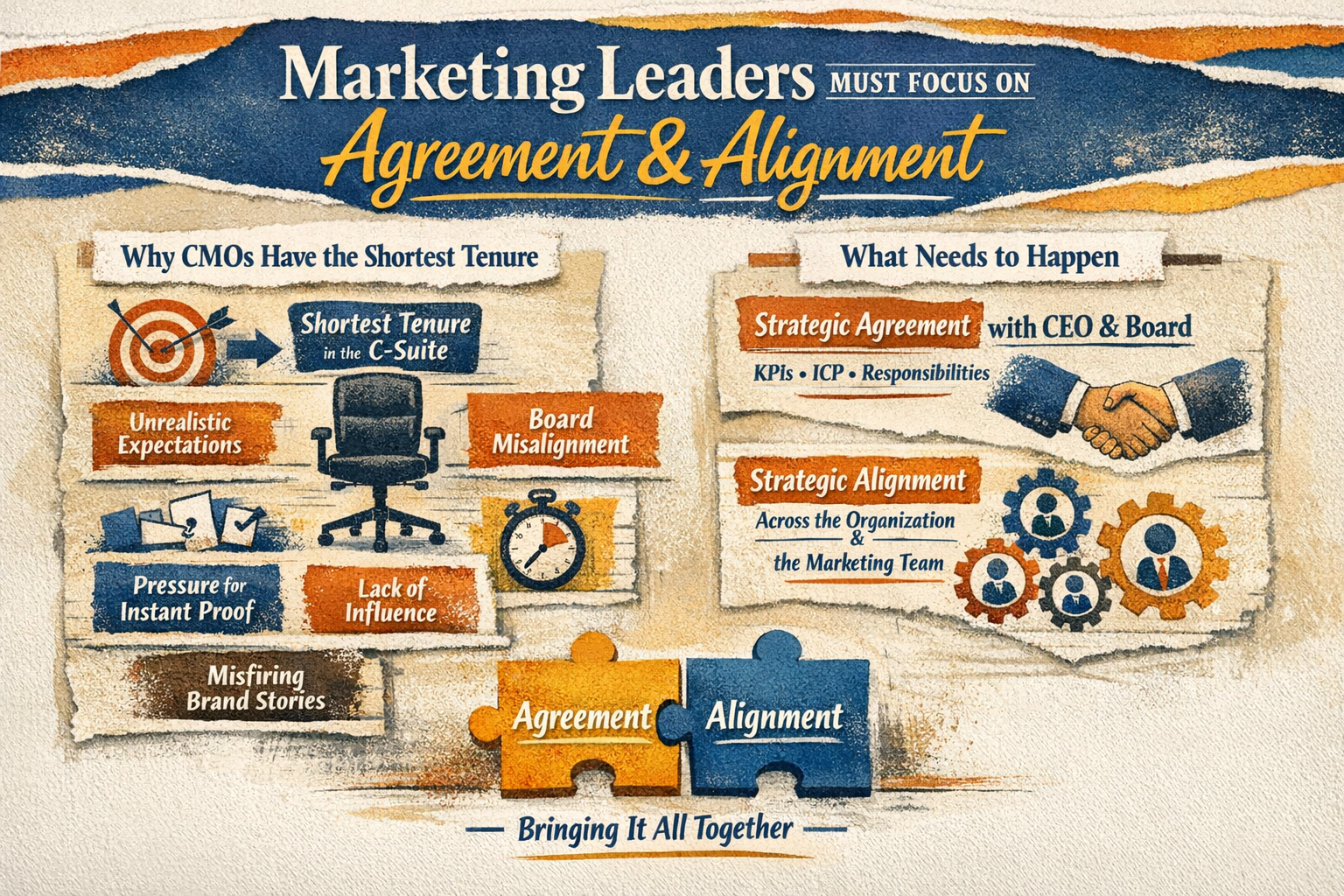
There are two elements to building a successful marketing team built for impact on the business: Agreement & Alignment.
Strategic Agreement with the CEO and the Board
Nothing works if this step is missed or not taken seriously.
The “Strategic Agreement” as stated includes three key items that must be discussed, debated, negotiated, and agreed:
Marketing’s KPIs
Only KPIs that Marketing has direct impact and control over can be included here. If Marketing doesn’t manage and oversee the Call Center, no active call center metrics can be included. For example, “Reduce call time resolution” would not be allowed, but “Reduce calls related to X” could be included as Marketing has a direct way to impact that metric. Something to remember here is that KPIs must be kept to a select few. Employees may have more that roll up to these top line metrics, but these are the numbers that matter most to the Board and the company’s success or failure.
Definition of Ideal Customer Profile
The Ideal Customer Profile, or ICP, is the key to everything. It defines the ideal customer and who we will be spending our time on in the short- and medium-term. It must also define who is not ideal and how they will be handled.
Why is it important to spell this out now and not later? If you spell it out now and Agree, when a shiny object idea pops up in conversation or through feedback, you can come back to the ICP statement and remind each party of the Agreement that was made. Straying from the ICP erodes the strategy and often negatively impacts outcomes.
Agreement on what Marketing is Accountable (to use the RACI model) for
This relates to the KPI statement, but it must be stated what Marketing has direct control over and where they must be Consulted on any business decisions. This isn’t about created buracracy, it is about Agreeing who is the champion and who rides the bench when it comes to decisions and strategy.
In my experience, this is one area that senior teams fail at the most. Everyone has opinions, very few should have weight given to those opinions because they technically are meant to just be Informed of decisions, not consulted and they are certainly not responsible for the outcomes.
With this secured, now the CMO must take this Agreement and evangelize it within the organization and the team on how they will make it a reality.
Strategic Alignment Across the Organization and the Marketing Team
This is where it either happens or it falls apart (and why the CMO never fully unpacks their cardboard boxes). I’ve done this before because I had the concern that no matter what was Agreed to wouldn’t be followed. And therein lies the grenade.
A CMO must be put in a situation—if the organization dreams of success—to make success inevitable.
In creating Strategic Alignment for the organization and the team, the CMO is putting a stake in the ground that is flexible enough to account for new ideas, changes in the market, and insights from the overall program.
This is called Strategic Alignment because the team needs to align behind the implementation strategy that supports the Agreement. This is alignment to the organization, marketing team, and the Strategy.
In my experience, six times out of ten, this is where marketing fails. Rather, this is where organizations fail marketing.
We Agreed on strategy, but then no one allowed the execution in the Alignment phase to occur. When this happens, numbers don’t improve, morale drops, and the CMO leaves.
First comes agreement with the CEO and the Board, then the CMO drives the Alignment across the organization.
This structure eliminates scope creep (or at least creates a framework to protect against it), blocks against shiny object syndrome, and empowers the CMO to create the very change they are often hired to undertake.