
Improve Customer Experience with Engaged AI
Banking is changing rapidly.
After spending years in a variety of credit unions of vastly different sizes, I can say without hesitation that we have just begun the transformation that will shape the next generation of financial service experiences.
Growing up, I knew my personal banker’s name. Her name was Mary and I had her email address and knew where her desk was in the bank by the mall. Mary had been my family’s personal banker for years. There was trust there; an ease of communication and an understanding of our goals and challenges.
This was over 20 years ago, but the change was already happening when I drove away to college.
She transitioned into a new job. I lost my personal connection.
Over the years I would open new accounts and close them without even a conversation. No one knew me, my goals, or where I was going.
Then came my move to New York City and Bitcoin was born. Then Venmo.
Now we have Cash App, Square, Chime, Coinbase, and too many other fintech players to count.
All this in 20 years.
And yet, account opening is still broken. Onboarding is fragmented. Loan approvals sit in their own silo. And don’t even get me started on customer service or situational awareness.
What’s Changing in Banking?
I wrote in late 2025 about the pain and backlash of AI; and it is still real. But now we have a bit more color from a study by Plaid and the Harris Poll about how the generations are viewing Artificial Intelligence in relation to their finances.
A story on The Financial Brand quotes Adam Westley, chief revenue officer at Digital Onboarding, where he details the difference in what large banks call personalization and what customers actually experience: “For larger institutions, personalization involves using a person’s name and slotting them into a generic customer segment. That is consistency, not authenticity.”
This is where AI has to lead.
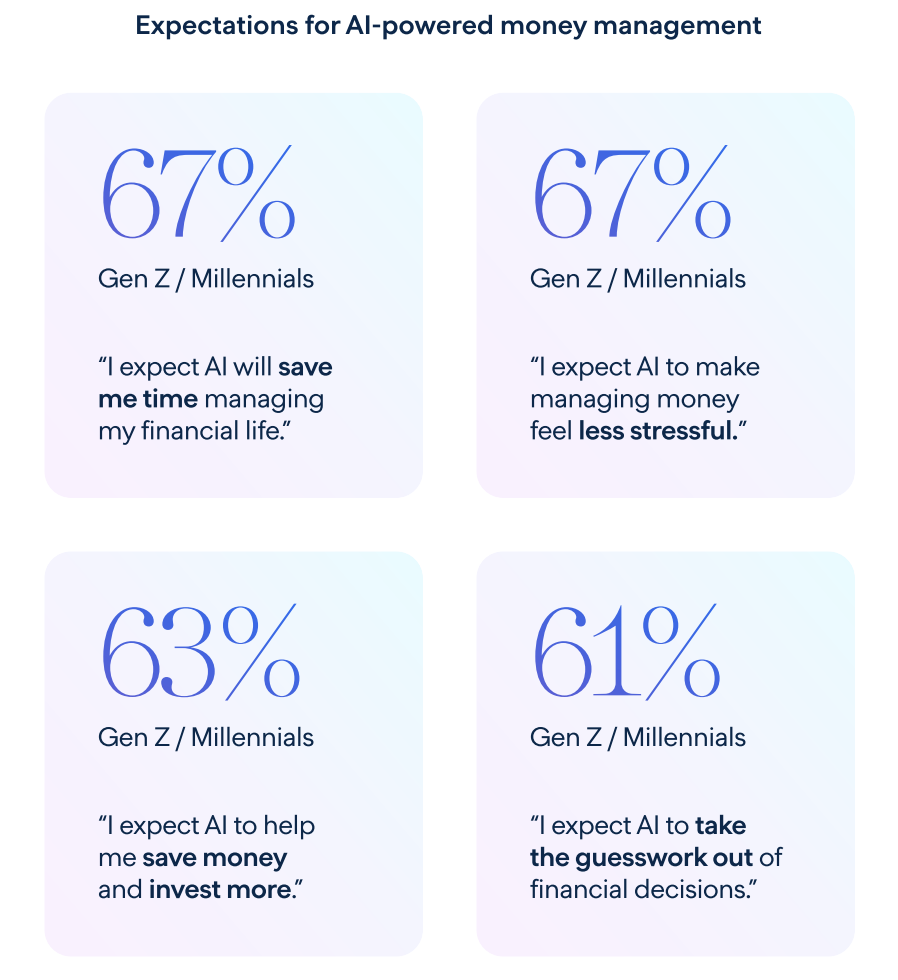
According to the Plaid/Harris Poll report, 52% of Americans expect fintech apps to use AI, rising to 59% among Gen Z and Millennials.
Financial app, Monarch has slowly integrated AI insights into their personal banking platform.
Live Financial Wellness is The Holy Grail
On a personal note, I have moved on from the “Which bank is best for me?” prompts and towards something like this:
I’m going to upload a spreadsheet with all of my family’s accounts detailed. In Column B is the time window for how long I feel comfortable locking in the funds, Column C is my current interest rate, and Column D is the current maturity date of the funds are already in a Certificate of Deposit. Please review this against market options and my goals and provide me with changes I should make to maximize returns given my goals for the cash.
And it worked. That’s AI providing financial guidance for me and my family.
No one has really mastered this or worked to build this out. It’s a black hole for consumers. But they want it.
Trust Remains the Most Important Asset
The value of trust can not be understated. According to the report, Trust is constructed through a specific hierarchy of protections. Comfort with AI and financial institutions is most significantly bolstered by guarantees of data protection (46%), full transparency regarding AI usage (45%), and human approval for major actions (44%).
That’s why it is important for credit unions and community banks to be singularly focused on bringing AI into their orgaizatnions with two lenses and an overarching ethos:
Improve employee experience (i.e. operations)
Improve the lives of members / customers
Wrapping those two together is the AI governing strategy (the Trust Layer).
What is Engaged AI?
Launching an Engaged AI strategy means bringing AI into life via an organization’s DNA that improves operations and operational efficiency to enhance the value-prop of the organization. It means AI empowers customers to have better insights and outcomes. It means AI isn’t a one-trick solution, but an enterprise way of life.